End-of-Summer Client Check-In Email Template
End-of-Summer Client Check-In Email Template
Late summer creates a useful moment for a travel consultant. Some clients have just returned from their main holiday, some are already thinking about autumn or winter, and others are beginning to plan much further ahead. Yet unless you give them a reason to reconnect, many of those conversations can quietly disappear into next year.
A thoughtful travel check-in email template can help you reopen the relationship without sounding like you are chasing a sale. The aim is not to send a generic “Are you ready to book again?” message to everybody in your database. It is to remind suitable clients that you are still there, show that you remember what matters to them and make it easy for them to tell you what they may be considering next.
For a travel homeworker, this kind of client care matters because repeat business is built between bookings as much as during them. A short, well-timed email can lead to useful feedback, a future holiday conversation, an updated preference, a referral or simply another positive touchpoint in a long-term client relationship.
Why the End of Summer Is a Natural Time to Check In
The end of summer sits at an interesting point in the travel calendar. Clients who travelled during the school holidays have fresh experiences to talk about. Couples and adults without school-date restrictions may be looking towards shoulder-season breaks. Winter-sun, festive, ski and cruise conversations are becoming more relevant, while long-term planners may already be thinking about the following year.
That gives you a genuine reason to make contact. You are not inventing urgency or forcing an offer into somebody's inbox. You are checking how their summer went, whether their travel priorities have changed and whether there is anything they would like help thinking through next.
If you have not contacted past customers for a while, our guide to re-engaging past travel clients with personalised emails explains how to organise your contacts, choose a sensible reason to reconnect and avoid making an email feel like a mass mailout.
The timing can also support future planning. Clients who say, “We probably want to do something big next summer,” do not need a full quote immediately. They may simply need you to record their ideas, agree when to speak again and make sure they are not forgotten. Our guide to long-term travel planning explores how those early conversations can become a useful future pipeline.
Who Should Receive an End-of-Summer Check-In?
Do not start by selecting your entire contact list. Start with people for whom the message has a believable purpose.
Useful groups may include:
- clients who travelled during spring or summer and have not had a proper post-trip conversation;
- repeat customers who normally begin planning their next holiday around this time of year;
- families who may soon start thinking about the next school-holiday period;
- clients who mentioned a future milestone, cruise, long-haul trip or special celebration;
- people who previously asked you to keep them informed about a particular style of travel;
- past clients whose preferences may have changed since their last booking.
There is an important difference between choosing a client because you have a relevant reason to contact them and simply sending to everyone because you want more enquiries. The first feels like personal service. The second can feel like a campaign wearing a personal disguise.
A travel homeworker does not need thousands of contacts for this to work. Ten carefully chosen emails that generate three genuine conversations can be more commercially useful than a large generic send that creates no meaningful replies.
What a Good Travel Check-In Email Should Actually Do
The best check-in email has one main job - make replying easy.
That means the email should not try to showcase every destination you sell, list dozens of offers or ask the client to complete a complicated questionnaire. It should remind them who you are, give a natural reason for the message and ask one or two simple questions that can restart a useful conversation.
A strong message usually contains four ingredients:
- A real connection. Refer naturally to the client, their previous trip or the time of year rather than opening like a newsletter.
- A service-led reason for writing. Ask how things went, whether their priorities have changed or whether anything new is starting to tempt them.
- One easy question. Give them something they can answer quickly from a phone.
- A low-pressure next step. Make it clear that they do not need firm dates, a final destination or a booking decision to start talking.
This is why a client check-in is different from a traditional promotional email. The conversation is the objective. The booking may come later.
End-of-Summer Travel Check-In Email Template
The following travel check-in email template is designed as a starting point rather than a script that should be sent unchanged. Adapt it to the individual client, your own voice and the reason you are getting in touch.
Subject line ideas
- How did your summer travels go?
- Thinking ahead after summer?
- A quick travel check-in
- Has anywhere started tempting you next?
- What is on your travel wish list now?
The template
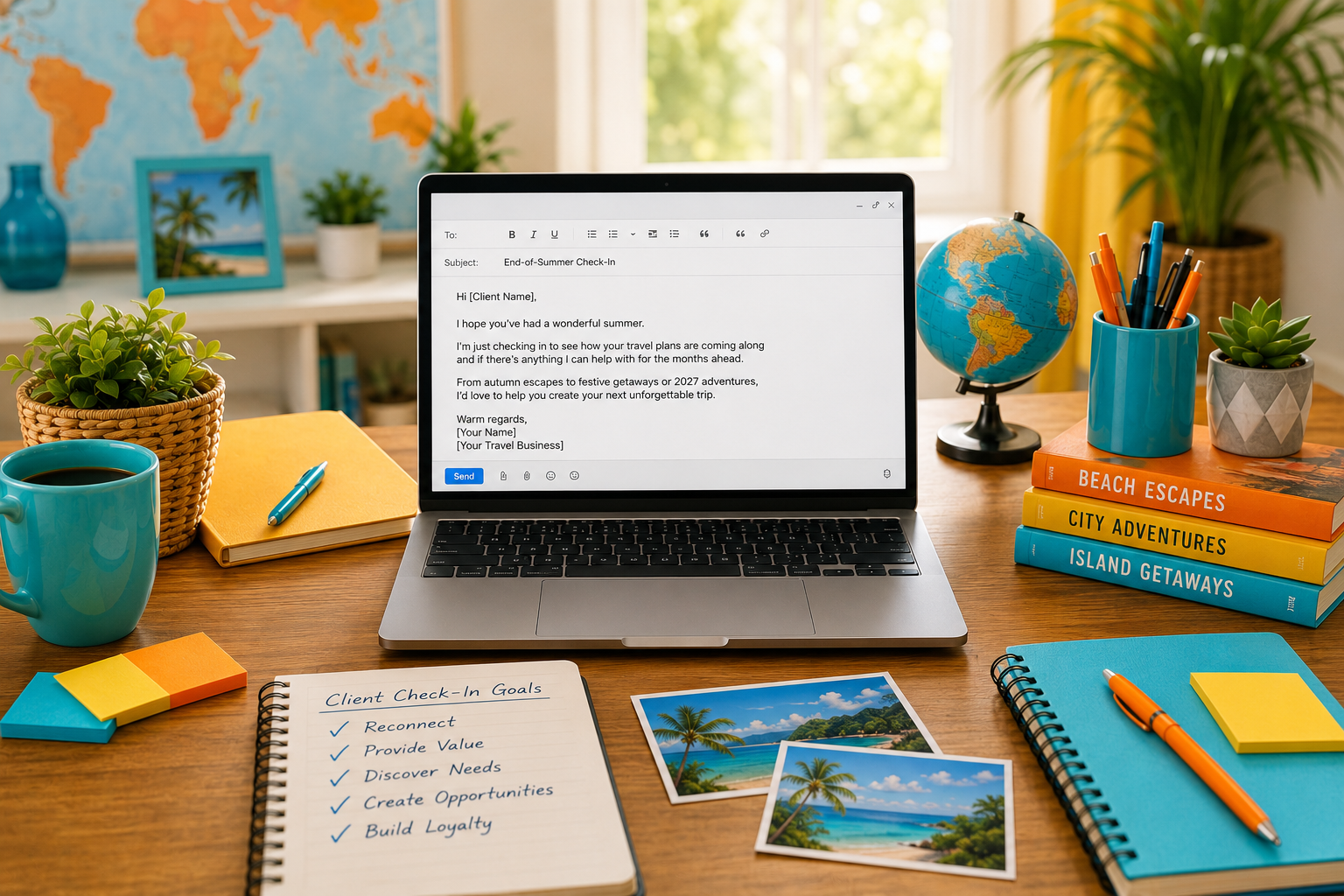
Hi [First name],
I hope you have had a lovely summer. I was thinking about [your trip to / the holiday we arranged in / your plans for] [destination or relevant detail] and wanted to check in.
How did everything go, and is there anything from the trip that you would definitely want to repeat - or do differently - next time?
I am also starting to have more conversations about autumn, winter and next year's travel, so I wondered whether anything new is beginning to tempt you. You do not need to have firm dates or even a destination in mind. If you have an idea, a month, a celebration or simply the feeling that you would like something to look forward to, reply and tell me what you are thinking.
If travel is not on the agenda at the moment, that is absolutely fine too. I just wanted to say hello and make sure you know I am here whenever the next trip starts taking shape.
Best wishes,
[Your name]
The strength of this email is its simplicity. It asks about the previous experience, creates an opening for future travel and removes the pressure to be “ready to book”. A client can answer with one sentence, and that is enough to give you a useful next step.
Personalise the Template Without Making It Feel Intrusive
Personalisation should show that you remember the client, not prove how much information you have stored about them.
A first name is helpful, but the stronger detail is usually something connected to the service you genuinely provided. Perhaps the client wanted a quiet hotel away from nightlife, needed easy airport transfers, loved a particular cruise style or told you they were hoping to plan a major anniversary trip in the future.
You might adapt one sentence like this:
- Family client: “I hope Majorca gave you the easy family break you were hoping for. Did the shorter transfer and kids' facilities work as well as expected?”
- Cruise client: “I remembered how much you enjoyed the smaller-ship atmosphere on your last sailing. Has another itinerary started catching your eye?”
- Long-haul client: “You mentioned that the next big trip might be Asia, so I wondered whether that idea is beginning to move up the wish list.”
- Milestone client: “You had mentioned wanting to do something special for next year's anniversary. There is no rush to decide where, but this could be a good time to start talking through ideas.”
Keep each reference relevant and comfortable. Do not insert sensitive personal details simply because they exist in a client record. A good test is whether you would naturally mention the same detail in a normal conversation.
If you want a more structured way to learn what clients are interested in, using short client surveys to understand your audience can help you gather preferences without turning every check-in email into a long list of questions.
Do Not Turn the Check-In Into an Offer Dump
One of the easiest ways to weaken a personal email is to add too much selling after writing it.
You may be tempted to finish the message with several cruise deals, a winter-sun graphic, a city-break offer and a reminder that summer dates are on sale. That changes the purpose of the email. The client stops feeling checked in on and starts feeling marketed at.
If a relevant product genuinely prompted the email, mention one idea and explain why it made you think of that client. Otherwise, wait for the reply. Once you know what they are considering, you can send inspiration that actually fits.
The same principle applies to urgency. If a genuine price deadline, low availability or supplier condition matters to a particular option, explain it accurately when it becomes relevant. Do not manufacture urgency simply to make the check-in convert more quickly.
For consultants who want to keep seasonal marketing useful rather than overwhelming, our guide to summer email marketing for travel clients shows how to balance inspiration with genuine client value.
Check Marketing Permission Before You Send
A friendly tone does not remove your responsibilities around electronic marketing.
If the purpose of your message includes encouraging future travel business, treat marketing permission seriously. Check the contact status recorded for the client, follow the processes provided by your business, include any required opt-out mechanism and honour unsubscribe requests. A past booking does not mean you can assume unlimited permission to send promotional emails forever.
This is particularly important if you plan to send the check-in to a larger group or build it into an automated sequence. Accurate client records and clear contact preferences protect both the client relationship and your business.
The wider guide to responsible past-client email re-engagement covers this point in more detail, including the need to check the basis on which you are contacting each person.
What to Do When the Client Replies
The email is only useful if the reply leads somewhere.
A client saying, “We are thinking about next Easter but have no idea where,” is not a vague response to file away. It is a new travel conversation. Ask a small number of discovery questions and agree what happens next.
Different replies need different follow-up:
- If they have a clear destination and approximate dates, move towards a proper enquiry or consultation.
- If they have a broad idea, ask about budget, preferred dates, departure airport and what they want the trip to feel like.
- If they are interested but not ready, record the likely planning window and schedule a sensible follow-up.
- If they have just returned and provide detailed feedback, capture anything that should shape future recommendations.
- If they are delighted with the service, there may later be a natural opportunity for a review or referral - but do not force both into the first check-in.
- If they are not planning travel, thank them for replying and leave the relationship on a positive note.
Good record keeping turns a warm exchange into useful business information. Our client travel checklist explains how post-travel feedback, future preferences and next-enquiry opportunities can become part of a consistent service workflow.
Use the Conversation to Build Repeat and Referral Business Naturally
Repeat bookings and referrals work best when they grow out of a strong relationship rather than appearing as a demand at the end of every email.
If a returning client tells you they had a brilliant holiday, listen first. Ask what they enjoyed. Record useful feedback. If the conversation develops naturally, you can later invite them to leave a review or recommend you to somebody else.
At the end of summer, this can be particularly effective because recent travellers are still talking about where they went. Our guide to creating an end-of-summer referral campaign explains how to make that process intentional without making clients feel that every positive comment has immediately become a sales opportunity.
Jamie Says:
Jamie Says:
“A check-in email should feel like the continuation of a relationship, not the beginning of a sales campaign. If the only reason you are writing is because you need another booking, the client will often feel it. Give them a genuine reason to reply, listen to what comes back and let the commercial opportunity develop from good service.”
Make the Template Part of a Repeatable Client-Care Routine
You do not need to wait until every August to use this approach. The end-of-summer version is useful because there is a natural seasonal reason to reconnect, but the underlying habit can work throughout the year.
Set aside a short period each week to review returned clients, future-planning notes and people approaching their usual booking cycle. Choose a small number who have a relevant reason to hear from you, adapt your template, send the message and record the outcome.
A simple routine might be:
- Review five to ten suitable client records.
- Check contact permissions and the last meaningful interaction.
- Choose one personal detail or genuine reason for getting in touch.
- Adapt the email so it sounds like you.
- Send it and record the date.
- Schedule a follow-up only where one is appropriate.
- Update preferences or future-travel notes when the client replies.
This kind of consistency is part of what makes travel homeworking a real business rather than a sequence of disconnected bookings. You are building a client base that remembers you, trusts you and knows how to restart the conversation.
A Note for Members of the Public
This article is mainly written for people considering travel homeworking and independent consultants who want to improve their client communication. If you are here because you are planning a holiday rather than building a travel business, you are equally welcome.
You can use our public directory to find a travel consultant in the UK whose interests and experience suit the trip you are planning, then contact them directly for personal help.
Frequently Asked Questions
When should I send an end-of-summer client check-in email?
Send it when there is a natural reason to reconnect rather than on an arbitrary date. Late August and early September can work well for clients who have recently travelled, families thinking about future school holidays, winter planners and people whose usual booking cycle is beginning. Your own client history is more useful than a universal “best day”.
How long should a travel check-in email be?
Usually short enough to read and reply to easily on a phone. You need a personal opening, a genuine reason for writing, one or two easy questions and a low-pressure next step. If the email becomes a full newsletter or quotation, it is probably trying to do too much.
Should I include travel offers in a client check-in?
Only when an offer or itinerary is genuinely relevant to the person and is part of the reason you thought of them. A personal check-in usually works better when it starts with the client's needs. Once they reply, you can recommend suitable products rather than guessing what they want.
Can I send the same template to every past client?
Use the same structure if it saves time, but adapt the message. A useful travel check-in email template gives you consistency without making every client receive identical wording. Also check that you are permitted to send marketing to each contact and follow your business's data and communication processes.
Do I need travel-industry experience to build this kind of client process?
No. Client communication is one of the skills that can be learned through training and practice. The Independent Travel Consultants supports both newcomers and experienced travel professionals with training in customer service, systems, enquiries, bookings, compliance and business development. Consultants are self-employed and build their own client base, so consistent relationship-building remains an important part of the role.
Turn Good Client Communication Into a Stronger Travel Business
A good end-of-summer check-in is not complicated. It reminds clients that there is a real person behind their travel arrangements, gives you the chance to learn what has changed and creates a natural opening for the next conversation.
That is one of the practical skills behind a sustainable independent travel business. Travel homeworkers need to find clients, but they also need to give existing clients a reason to return, recommend them and trust them with the next trip.
If you are exploring travel homeworking and want to understand the training, systems, supplier access and ongoing support available, read how you can become an Independent Travel Consultant in the UK. The Independent Travel Consultants is a self-employed business opportunity - consultants build their own client base while operating with the wider travel infrastructure and support provided through Jamie Wake Travel.
If that sounds like the kind of travel business you would like to build, get in touch for a discovery call. You can ask questions, understand how the model works and decide whether it is the right fit for you.
About Jamie Wake
Jamie Wake is the founder of The Independent Travel Consultants and Jamie Wake Travel, helping people build sustainable travel businesses with practical training, supportive systems and genuine guidance behind them.
Having built his own travel business following redundancy, Jamie understands the uncertainty, determination and learning involved in starting something new. He combines hands-on experience of running a UK travel company with knowledge of travel sales, customer service, marketing, supplier relationships, compliance and day-to-day business operations.
Through The Independent Travel Consultants, Jamie shares practical, honest guidance about becoming a travel homeworker, attracting and supporting customers and building a business that feels personal, professional and sustainable—not simply chasing bookings at any cost.