
Nurturing Clients Between Enquiry and Booking
Nurturing Clients Between Enquiry and Booking
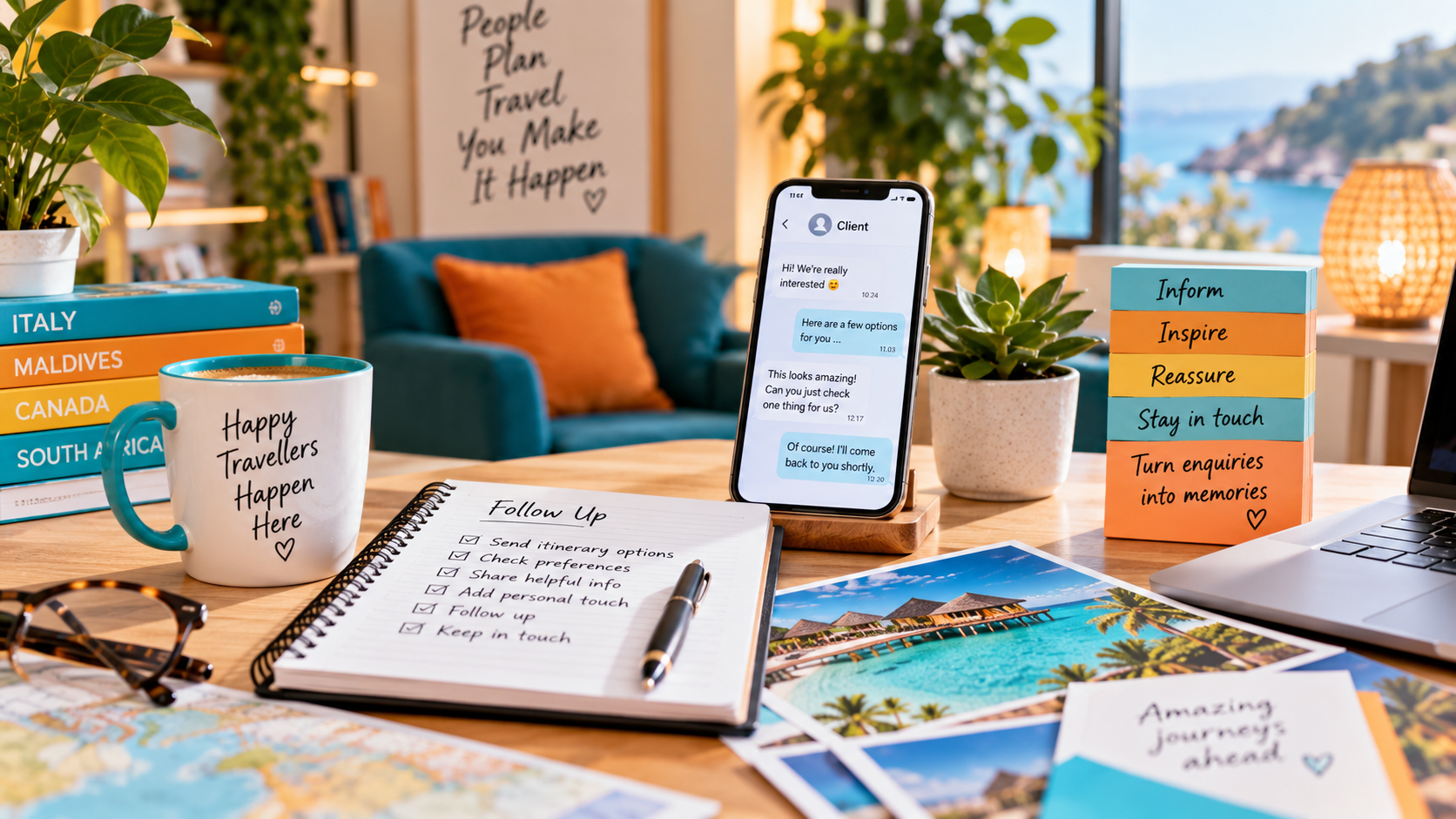
A travel enquiry rarely moves in a perfectly straight line from "We are thinking about going away" to "Please book it." Clients pause. They compare. They talk to partners, check annual leave, rethink budgets, ask family members and sometimes simply get distracted by everyday life.
That gap between enquiry and decision is where good client nurture matters. The best travel enquiry follow up tips are not really about chasing people more often. They are about staying useful while the client is deciding, so that your name remains associated with reassurance, expertise and a holiday that feels right for them.
For a travel homeworker, this stage is especially important because clients may never walk into an office or sit opposite you at a desk. Your communication becomes the experience. Done well, it helps a prospective client feel that they already have a travel consultant looking after them before they have spent a penny.
Nurturing is different from simply following up
A follow-up asks whether the client is ready to continue. Nurturing gives them another reason to continue.
That difference matters. A message saying "Have you had a chance to look at the quote?" asks the client to do something for you. A message that says, in effect, "I remembered that the children's club mattered to you, and I have checked the opening dates" gives them something useful.
Both have a place, but the second creates value while the decision is still being made.
If you need the basic timing and structure of a follow-up process, our existing guide to a follow-up strategy that turns enquiries into sales covers that in more detail. This article focuses on what should happen around those touchpoints so the relationship becomes stronger rather than simply more frequent.
Start nurturing during the first conversation
Client nurture does not begin after the quote. It begins when the client first tells you what they want.
The better you understand the reason behind the holiday, the easier it becomes to stay relevant later. A client saying they want Tenerife is useful. Knowing that they want Tenerife because they need winter sunshine, a short flight, a hotel where their teenager will not be bored and somewhere they can walk to restaurants gives you much more to work with.
Listen for the details that reveal priorities:
- what they are most excited about;
- what went wrong on a previous holiday;
- who in the travelling party is hardest to please;
- what would make them spend more;
- what would make them reject an otherwise good option;
- and what they are nervous about getting wrong.
These are not just research notes. They are the basis of useful future communication.
If you are still developing the initial conversation itself, our guide to mastering the travel consultation is a natural place to start.
Do not let the client feel forgotten while you are researching
Some holidays can be quoted quickly. Others take time. A complicated multi-centre itinerary, cruise combination or important family trip may involve considerably more research.
The client does not need a running commentary on every supplier search, but they should not be left wondering whether anything is happening.
If your research is taking longer than expected, update them. A simple message explaining that you are comparing two routing options, checking a particular room configuration or waiting for clarification from a supplier shows that the delay has a purpose.
This is particularly useful for a home-based independent travel agent because professionalism is often demonstrated through communication rather than a physical shopfront. Setting expectations early also protects your own workload. Our guide to managing travel enquiries without losing control of your workload looks at that side of the process in more detail.
Use the quote as the beginning of a conversation
A quote should not feel like a document thrown over the wall for the client to judge alone.
When you present the options, bring the original conversation back into view. Explain why a hotel, itinerary or flight combination made the shortlist. Refer to the client's own priorities in natural language.
For example, instead of saying that a resort has three swimming pools, you might explain that the layout gives their children plenty to do without choosing the huge, busy resort they said they wanted to avoid. Instead of simply listing a sea-view room supplement, explain why you think it is or is not worth the extra money for this particular trip.
This is where good travel consultancy separates itself from search results. Facts matter, but relevance matters more.
Our article on emotional storytelling in travel sales explores how to help clients picture the experience without turning a professional recommendation into exaggerated sales language.
Give every contact a reason to exist
One of the easiest ways to make follow-up feel pushy is to contact a client repeatedly without adding anything.
Before sending a message, ask yourself: what is useful about this contact?
You might have:
- checked a question the client raised;
- found a better flight combination;
- noticed that one option offers a meaningful inclusion the other does not;
- confirmed whether a facility is suitable for their travelling party;
- found a room category that solves a concern;
- clarified a genuine availability or pricing change;
- or simply realised that one option better matches what they originally told you.
Not every message needs major new information. Sometimes the useful purpose is simply to ask one focused question that helps the client make the next decision.
"Are you leaning towards the better hotel or keeping the overall price down?" is more useful than "Any thoughts?" because it helps the client organise their own thinking.
Match your nurturing to where the client actually is
Not every enquiry should receive the same sequence. A couple hoping to depart in three weeks needs a different pace from somebody researching a once-in-a-lifetime trip for eighteen months' time.
The client who is nearly ready
They are asking specific questions, comparing two options or checking payment details. Keep the communication focused on removing the last points of uncertainty. This is not the moment to introduce six new hotels and send them back to the beginning.
The client who is interested but undecided
They may still be working out what matters most. Help them compare choices rather than repeatedly asking whether they want to book. A concise explanation of the trade-offs can be more useful than another price search.
The long-range planner
They may not be ready to commit immediately, particularly for an expensive holiday. Stay relevant without filling their inbox. Useful destination insight, a planning milestone or a genuine change in availability can maintain the relationship until the decision becomes more immediate.
The client who has gone quiet
Silence does not always mean rejection. They may be busy, have changed dates or be waiting for somebody else. Follow up professionally, but know when to step back. If the enquiry has genuinely cooled, our guide to what to do when a travel client stops responding covers how to handle that without damaging the relationship.
Remember the little things the client told you
Personalisation becomes much easier when you keep useful notes.
If a client mentions that they hate very early flights, do not send a 5.45am departure three days later without acknowledging it. If a parent explains that one child is nervous around deep water, remember that when talking about waterparks or boat excursions. If they say their last hotel was too remote, location needs to stay central to the recommendation.
This does not require remembering every detail in your head. Record important preferences in your CRM or enquiry notes so you can pick up the conversation properly each time.
The effect on the client can be significant. Remembering a small detail demonstrates that you were listening, and listening builds trust faster than a generic sales message.
Do not use nurture as an excuse to bombard the client
Useful communication still needs breathing room.
If the client has told you they will discuss the holiday at the weekend, respect that. If they are waiting for annual leave approval on Tuesday, sending messages on Sunday and Monday will not speed up the decision.
Good nurturing recognises the next natural moment for contact. Sometimes the most professional thing you can do is leave the client alone until the time you agreed.
It also helps to establish a preferred communication channel. Some clients respond fastest on WhatsApp, while others want everything by email so they can review it together later. A professional client journey adapts where sensible rather than insisting that every customer communicates in exactly the same way.
Our guide to keeping travel clients updated and informed looks more broadly at setting communication expectations throughout the relationship.
Know the difference between reassurance and pressure
Clients sometimes hesitate because they are unsure about the destination, financial protection, the amount of money involved or whether they are making the right choice.
Your job is to answer the concern accurately, not manufacture urgency to overpower it.
If availability is genuinely limited, explain that fact. If the price is live and subject to change, say so. If you do not know whether something will still be available tomorrow, be honest rather than pretending certainty.
Trust is particularly important before a first booking because the client is deciding not only whether they like the holiday, but whether they are comfortable placing their money and plans in your hands.
For people working through The Independent Travel Consultants, clients have the reassurance of professional systems and financial-protection processes behind the consultant, while the consultant remains responsible for delivering the personal relationship and service. The wider travel sales funnel should therefore build confidence rather than force a decision.
Watch for buying signals and change the conversation
At some point, a client stops researching the idea of a holiday and starts working out whether they can book this holiday.
The questions often change:
- "How much is the deposit?"
- "When would the balance be due?"
- "Can we add the transfer later?"
- "What names do you need from us?"
- "Can you hold it while I speak to my partner?"
- "What happens once we say yes?"
These are buying signals. Respond clearly and helpfully, but do not skip the required booking steps.
This is where nurturing should become process. Explain what the client needs to provide, how authorisation and payment work, and what will happen after the booking is made. At The Independent Travel Consultants, consultants are trained to follow the correct booking process rather than treating an enthusiastic message as permission to book.
If you want the full end-to-end view, our guide to the travel booking journey from enquiry to payment explains how the stages connect.
A simple nurture framework for travel homeworkers
You do not need a complicated marketing automation system to nurture enquiries well. A straightforward framework can keep the process personal:
- Listen: understand why the trip matters and what could make or break it.
- Record: keep the client's priorities somewhere you can reliably refer back to.
- Set expectations: tell them what you are doing and when they will hear from you.
- Recommend: connect the options to what the client actually told you.
- Add value: make follow-up useful rather than repetitive.
- Adapt: respond to how their thinking changes instead of restarting the search unnecessarily.
- Give space: respect agreed decision times and avoid unnecessary messages.
- Recognise readiness: when the questions become about deposits, names or next steps, guide them into the proper booking process.
The goal is not to keep an enquiry alive forever. It is to make sure a good potential client never drifts away simply because the experience became vague, impersonal or difficult.
Jamie Says:
"Clients rarely need more chasing. They need more confidence. Remember what they told you, give them useful reasons to come back into the conversation and know when to give them space. If every contact feels like help rather than pressure, the relationship is already moving in the right direction."
For members of the public reading this article
This guide is mainly written for people considering travel homeworking or developing their skills as a travel consultant. If you are planning a holiday yourself, it also gives you a useful idea of what thoughtful travel service can look like before you book.
You can browse our public directory and choose an independent travel consultant whose interests, experience or specialist knowledge fit the trip you are planning.
Frequently asked questions
How often should I follow up a travel enquiry?
There is no single frequency that suits every enquiry. Consider the departure date, value and complexity of the trip, what the client has told you and when you agreed to speak again. Useful, well-timed contact is more effective than contacting every lead according to an inflexible schedule.
What should I say instead of "just checking in"?
Give the message a purpose. Refer to something the client told you, answer a question, clarify a difference between options or ask one focused question that helps them decide. The message should move the conversation forward rather than simply remind them that you exist.
How can I follow up without sounding pushy?
Be transparent, useful and respectful of the client's timescale. Do not invent scarcity or pressure them after they have told you when they expect to decide. Good follow-up feels like assistance because it is based on what the client needs next.
Should every enquiry receive the same follow-up sequence?
No. A client travelling next month may need faster communication than somebody researching a major holiday for next year. The stage of the decision, complexity of the trip and the client's own preferences should shape the approach.
What if a client tells me they are comparing other travel agents?
Stay professional. Focus on the quality of your own advice and service rather than criticising another business. Make your recommendation clear, answer the client's questions accurately and allow them to decide which service gives them the most confidence.
Do The Independent Travel Consultants give homeworkers clients to nurture?
The Independent Travel Consultants provides training, systems, supplier access, financial-protection processes and ongoing support. Consultants operate as self-employed businesses and build their own client base, so developing relationships, generating enquiries and nurturing those enquiries professionally are important parts of travel homeworking.
Turn good enquiries into lasting client relationships
The strongest travel businesses are not built on one clever closing line. They are built on clients who feel heard, supported and confident from the first conversation onwards.
Learning how to nurture an enquiry is part sales skill, part customer service and part organisation. It is also one of the advantages a real travel consultant can offer over an anonymous booking journey.
If you are considering building your own travel business, you can learn more about the training, systems and support available when you become an Independent Travel Consultant.
And if you would like to understand the model before making any decision, get in touch to arrange a discovery call and ask us the questions that matter to you.
About Jamie Wake
Jamie Wake is the founder of The Independent Travel Consultants and Jamie Wake Travel, helping people build sustainable travel businesses with practical training, supportive systems and genuine guidance behind them.
Having built his own travel business following redundancy, Jamie understands the uncertainty, determination and learning involved in starting something new. He combines hands-on experience of running a UK travel company with knowledge of travel sales, customer service, marketing, supplier relationships, compliance and day-to-day business operations.
Through The Independent Travel Consultants, Jamie shares practical, honest guidance about becoming a travel homeworker, attracting and supporting customers and building a business that feels personal, professional and sustainable—not simply chasing bookings at any cost.