Creating Your Autumn Marketing Action Plan
Creating Your Autumn Marketing Action Plan

Autumn can be one of the most productive marketing periods in a travel business, but only if you decide what you want the season to do for you. Without a plan, September quickly becomes a stream of supplier offers, October disappears into reactive social posts and November arrives before you have built any real momentum.
For a travel homeworker, a better approach is to treat autumn as a three-month business window. You are not only marketing autumn holidays. You may be nurturing winter-sun enquiries, festive breaks, ski trips, cruises, family travel, spring departures and longer-term plans for 2027. The job is to connect the right message with the right client at the right time.
This guide is about the kind of autumn marketing travel agents can actually sustain alongside enquiries, bookings and client service. It will help you choose priorities, build campaigns around real client needs, organise your weekly activity and measure whether your marketing is creating useful conversations rather than simply keeping you busy.
Start With What August Already Taught You
Before deciding what to post in September, look backwards. Your own recent business is usually a better source of marketing intelligence than a generic list of seasonal ideas.
Review the enquiries, bookings, client questions and marketing activity from August. Which destinations kept appearing? Which posts led to actual conversations? Were clients asking about 2027, winter sun, Christmas, cruises or short breaks? Did one type of enquiry repeatedly stall because people were not ready, did not understand the value of using a travel consultant or needed more information before they could make a decision?
Your recent August travel business review can give you the raw material for your autumn plan. If ten clients asked about family holidays but only two were ready to book, that may suggest a nurturing campaign rather than more generic family offers. If a destination post created several direct messages, it may deserve a deeper guide, email or live Q&A.
This also prevents a common marketing mistake: changing direction simply because the calendar changed. September does not erase what your audience cared about in August. Good seasonal marketing builds from real behaviour rather than starting again from zero.
Choose Three Autumn Marketing Objectives
A marketing plan becomes useful when it tells you what not to do. If every possible objective is equally important, nothing is truly prioritised.
Choose no more than three outcomes for the season. For example, you might decide that your autumn priorities are to generate more winter-sun enquiries, reconnect with past clients and build your 2027 pipeline. Another consultant may prioritise cruise, local awareness and growing an email list. Both plans can work because they are connected to different businesses.
Try to make each objective measurable. “Post more on Facebook” is an activity, not an outcome. “Generate ten qualified winter-sun enquiries by the end of October” gives you something to work towards and review. “Grow my email list by 30 relevant subscribers” is more useful than simply saying you want more followers.
One of the strongest lessons from using recent business insights to prepare autumn campaigns is that your marketing should respond to what clients have already shown you. The objective is not to fill a content calendar. It is to create more of the right conversations.
Decide Who Each Campaign Is For
Travel marketing becomes clearer when you stop talking to “everyone who likes holidays”. An independent travel agent may sell a wide range of products, but each campaign still needs a recognisable audience.
You could segment your autumn activity around groups such as:
- families beginning to think about future school holidays;
- couples who can travel outside peak dates and may suit shoulder-season escapes;
- past cruise clients who may be ready to discuss another sailing;
- clients who regularly take winter-sun holidays;
- people planning a milestone birthday, anniversary or honeymoon;
- long-term planners considering a more complex 2027 trip;
- past enquiries that never converted but may now have clearer dates or budgets.
Once you know who a campaign is for, your content becomes much easier to write. A post aimed at a couple looking for a quiet October spa break should sound different from an email to a family planning next summer. The destination may even be the same, but the reason for travelling, the timing and the questions you need to answer will be different.
If your audience includes adults who can travel outside school holidays, your shoulder-season travel marketing can focus on atmosphere, value, temperatures, quieter resorts and flexibility rather than simply posting a reduced price.
Build Autumn Around Campaign Themes, Not Random Posts
A strong action plan is easier to manage when several pieces of marketing support the same commercial theme. Instead of choosing a different idea every day, give each period a clear purpose.
September: reconnect and reset
September is a natural month for re-engaging people after the summer. Clients return to routines, families start looking ahead to school breaks and many people begin thinking about having something else in the diary.
Your content could combine end-of-summer client check-ins, winter-sun inspiration, shoulder-season ideas, future family travel and reminders that early planning does not require every detail to be decided immediately. If you are promoting autumn escapes themselves, the key is to connect the product to a real need. The approach in our guide to planning an autumn retreat offer is a good example: start with the client who wants the break, not the spa photograph you happen to have available.
October: solve a more specific travel problem
By October, narrow the focus. One week might be about winter sun for couples. Another could explain family spring travel. A cruise specialist may begin nurturing people who are likely to respond to future cruise promotions. A luxury consultant might focus on festive escapes, special occasions or more complex long-haul planning.
This is where useful content earns attention. Instead of “Five places to go this winter”, you could explain which destination suits clients who want guaranteed heat, which works better for a shorter flying time, where adults-only options are strongest or what a family should consider before choosing an all-inclusive resort.
November: prepare for the next buying cycle
November can easily become dominated by discount messaging. Supplier promotions can be valuable, but they should not replace your own strategy. Decide in advance which clients you are trying to help and what role any promotional period plays in your wider plan.
If an offer is genuinely useful, explain it accurately and to the right audience. If it is not relevant, you do not need to promote it simply because everybody else is. Your marketing can also begin preparing clients for longer-term planning, future cruise promotions, spring travel and the next year’s main booking periods.
Your guide to using travel trends in your marketing strategy can help you separate a useful trend from a short-lived talking point that has little connection to the clients you actually want.
Use a Content Mix That Builds Trust Before It Asks for the Sale
A travel business cannot survive on inspiration alone, but it should not feel like a never-ending supplier brochure either.
A practical autumn content mix might include:
- Useful guidance that answers real travel questions, removes uncertainty or explains a decision.
- Inspiration that helps people imagine the type of trip they may want next.
- Proof such as client stories, your own travel experience, supplier training, destination knowledge or examples of how you solved a travel problem.
- Conversation starters such as polls, questions, short emails and client check-ins.
- Commercial content including suitable offers, availability, booking windows and clear reasons to enquire.
You do not need an exact mathematical ratio. The point is to stop every post trying to do the same thing. A helpful destination comparison may not create an enquiry today, but it can make a future sales post more credible because the audience already understands that you know the product.
If creating content regularly feels overwhelming, build from your existing travel marketing content bank. One client question can become a social post, an email paragraph, a short video prompt and a future FAQ. One supplier training session may give you several useful client-facing talking points without copying the supplier’s promotional wording.
Make Each Campaign Work Across More Than One Channel
Planning does not mean creating completely different content for Facebook, Instagram, email, your website and every other channel.
Start with one core idea. Suppose your campaign theme is “winter sun for people who hate long flights”. You could create a useful website article, shorten the main comparison into a social post, turn one question into a Reel, send an email to relevant clients and use client replies to shape a follow-up piece.
The message stays consistent while the presentation changes. This saves time and makes your expertise easier to recognise.
For a new travel homeworker, it is usually better to use a small number of channels consistently than to open accounts everywhere and struggle to maintain them. Choose the places where your likely clients already spend time, then make sure your website or enquiry route gives them an obvious next step.
If you want to grow an audience you can contact beyond social media, a useful seasonal resource can also support lead generation. Our guide to creating a seasonal travel lead magnet explains how a relevant free guide can attract people who are genuinely interested in the type of travel you want to sell.
Let Supplier Offers Support the Plan Rather Than Control It
Supplier marketing can save time and give you timely commercial opportunities, but your action plan should not become a schedule dictated entirely by whichever email landed in your inbox that morning.
Start with your objective and audience, then look for suitable supplier products. If you are trying to generate family spring enquiries, a relevant family offer may strengthen the campaign. If your autumn priority is long-haul luxury, an unrelated weekend-break promotion does not deserve space simply because the artwork is ready-made.
When you use supplier content, add your own value. Explain which client it might suit, what the important inclusions are, what should be checked before booking and why you are highlighting it. That is the difference between sharing a deal and acting as a travel consultant.
Always make sure the information you publish is accurate and current, and follow your business processes for pricing, availability, advertising and compliance. A professional independent travel consultant should be able to explain what is being offered rather than simply reposting a graphic.
Jamie Says:
“The best autumn marketing plan is not the one with the most posts in it. It is the one you can look at and immediately understand who you are trying to reach, what you want them to do and what you need to do next. If a supplier offer helps that plan, use it. If it distracts from it, you are allowed to leave it alone.”
Create a Weekly Marketing Rhythm You Can Actually Maintain
The plan has to fit around running the travel business. A consultant who spends every available hour producing content but has no time to respond to enquiries has not created a successful marketing system.
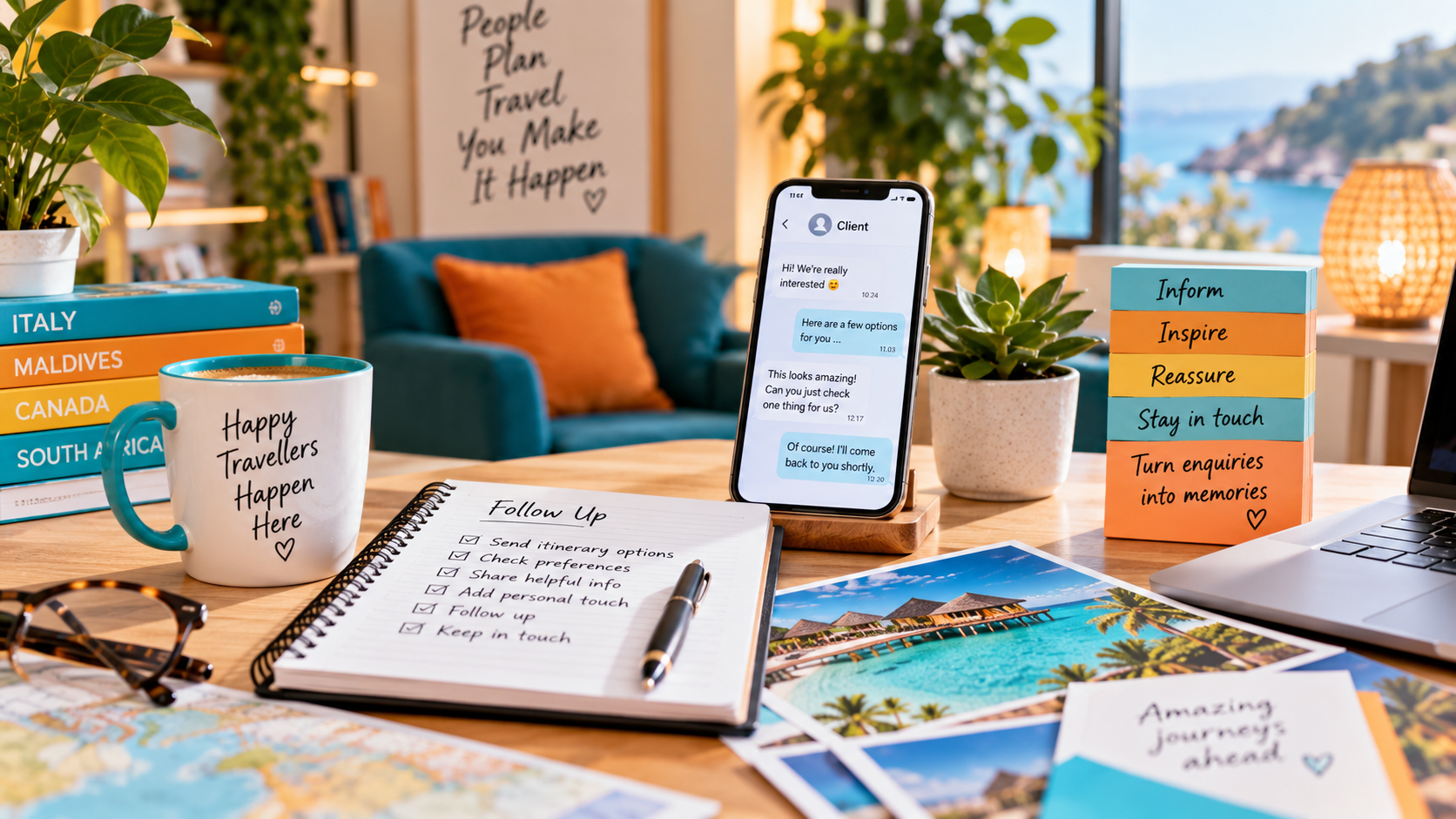
A simple weekly rhythm can keep things moving without turning marketing into a full-time job of its own. At the beginning of the week, review enquiries, follow-ups and any important supplier updates. Publish or schedule one useful piece of content linked to your current campaign. Send one targeted email or client communication where appropriate. Spend some time engaging rather than only broadcasting. Then finish the week by recording what created meaningful responses.
Some weeks will need more activity and some less. The important point is that follow-up belongs inside the marketing plan. An enquiry generated by a post is not a marketing success if it sits unanswered. A client who says “maybe next year” should not disappear because you forgot to record when to contact them again.
Travel homeworking rewards consistency because your client base develops over time. Marketing is not separate from client service. The way you answer, remember preferences, follow up and stay useful between bookings is part of how people decide whether to use you again.
Measure Conversations and Enquiries, Not Just Likes
Reach and engagement can be useful signals, but they are not the whole result.
Track a small set of measures that connect to your autumn objectives. These might include qualified enquiries, consultations booked, email replies, repeat-client conversations, new email subscribers, referrals, quote requests and ultimately bookings.
Also record which themes produced those results. If a modest Facebook post generated two serious cruise enquiries, that may be more valuable than a Reel that attracted thousands of views from people who will never buy from you.
At the end of each month, ask:
- Which campaign generated the most relevant conversations?
- Which content helped clients understand something they were unsure about?
- Which channel produced enquiries rather than passive engagement?
- Which audience segment responded most strongly?
- Which activities took a lot of time without producing a useful result?
- What should be repeated, improved or stopped next month?
That review turns autumn marketing into a learning cycle. You are no longer guessing what to do in October because you have evidence from September.
Your Autumn Action Plan in One Page
If you want to simplify everything in this article, your seasonal plan only needs to answer a handful of questions:
- What three business outcomes do I want from autumn?
- Which client groups are most relevant to those outcomes?
- What travel themes will I focus on in September, October and November?
- Which two or three marketing channels will I use consistently?
- What useful content can I create once and adapt across those channels?
- Which supplier offers genuinely support the plan?
- How will I follow up when somebody responds?
- Which numbers will tell me whether the plan is working?
Keep that plan visible. It should help you make decisions quickly. When a new marketing idea appears, ask whether it supports one of those priorities. If it does, add it. If it does not, save it for another time.
A Note for Members of the Public
This article is mainly written for people considering travel homeworking and independent consultants who want to build a stronger travel business. If you found it while looking for help planning a holiday, you are very welcome here too.
Our public directory can help you find an independent travel consultant whose interests and experience suit the type of trip you are planning. You can contact the consultant directly for personal help with your holiday.
Frequently Asked Questions
When should travel agents start autumn marketing?
Planning should begin before the season becomes busy, but you do not need months of finished content in advance. Late August and early September are useful times to review recent results, choose priorities and map the next few weeks. The important thing is to plan early enough that you are not reacting to every supplier promotion at the last minute.
What should a travel agent promote in autumn?
That depends on your clients and business. Autumn marketing may include shoulder-season travel, winter sun, festive breaks, ski, cruise, spring travel, family holidays and longer-term bookings. Do not assume autumn marketing means only selling holidays that depart in autumn.
How often should a travel homeworker post on social media?
There is no universal number that guarantees enquiries. Choose a frequency you can maintain while still responding properly to clients. Consistent, useful content aimed at the right audience is more valuable than posting every day simply to satisfy a schedule.
Do I need to spend money on advertising?
No. Paid advertising can be useful when you have a clear audience, offer and enquiry process, but it is not a requirement for building a travel business. Email, referrals, useful content, networking, client follow-up and organic social media can all contribute. If you do use paid advertising, decide in advance what result you expect and how you will measure it.
Does The Independent Travel Consultants provide marketing support?
Yes. The current ITC model includes training in social media and marketing basics, marketing guidance, branding guidance, compliance support and ongoing help. Consultants are self-employed and build their own client base and identity, so the aim is to help you develop marketing that fits your business rather than hand everybody identical pre-made campaigns.
Can I build a travel business from home if marketing is new to me?
Yes, provided you are prepared to learn and practise. Marketing is one part of the wider role, alongside customer service, enquiries, quoting, booking processes and business administration. You do not need to become a professional marketer before you start. You need a clear plan, consistency and the willingness to improve based on what clients respond to.
Build a Travel Business With a Plan Behind It
Marketing feels much less overwhelming when it stops being an endless demand for new ideas. A good autumn action plan gives your activity a reason. You know who you are speaking to, what you are trying to achieve and how you will recognise progress.
That matters if you are considering becoming a travel homeworker because building a client base is a real part of the business. The Independent Travel Consultants provides the wider travel infrastructure, training, supplier access, systems and ongoing support, while consultants develop their own client relationships and market their businesses consistently.
If you want to understand the current opportunity, costs, commission, training and support, explore how to become an Independent Travel Consultant in the UK.
If the model sounds like the kind of business you would like to build, get in touch for a discovery call. It is an opportunity to ask questions, understand how the homeworking model works and decide whether The Independent Travel Consultants is the right fit for you.
About Jamie Wake
Jamie Wake is the founder of The Independent Travel Consultants and Jamie Wake Travel, helping people build sustainable travel businesses with practical training, supportive systems and genuine guidance behind them.
Having built his own travel business following redundancy, Jamie understands the uncertainty, determination and learning involved in starting something new. He combines hands-on experience of running a UK travel company with knowledge of travel sales, customer service, marketing, supplier relationships, compliance and day-to-day business operations.
Through The Independent Travel Consultants, Jamie shares practical, honest guidance about becoming a travel homeworker, attracting and supporting customers and building a business that feels personal, professional and sustainable—not simply chasing bookings at any cost.