Repackaging Supplier Content to Match Your Brand
Repackaging Supplier Content to Match Your Brand
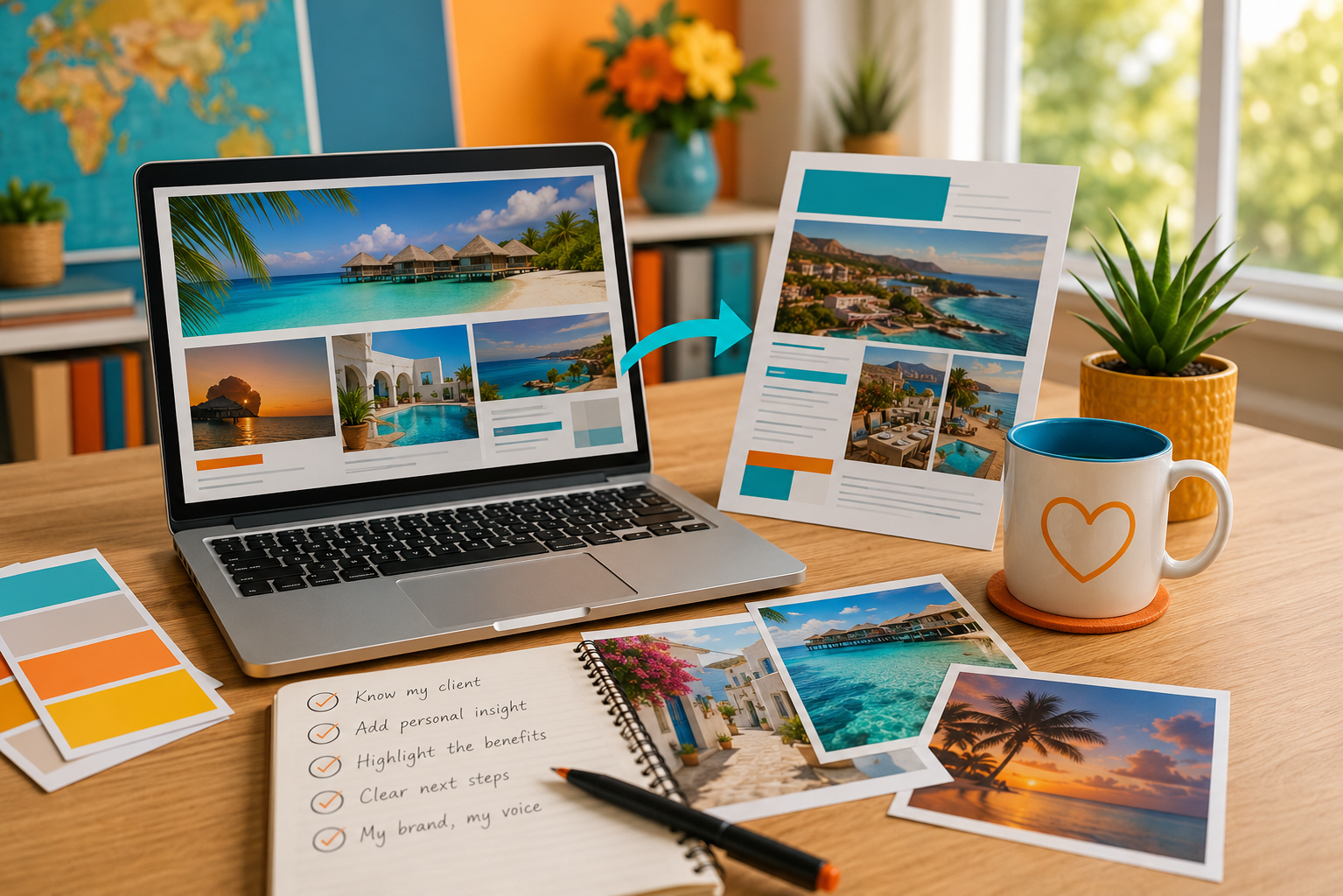
Supplier content can save a travel homeworker valuable time. Tour operators, cruise lines, hotel groups and tourist boards regularly provide photographs, videos, offer graphics, product descriptions and campaign ideas that are designed to help travel agents sell.
The difficulty is that the same material may be shared with hundreds or thousands of other consultants. If everyone publishes the same image, headline and caption, the client remembers the supplier or the deal, but may not remember the independent travel consultant who shared it.
Customising supplier offers allows you to keep the accurate product information while presenting it through your own brand, voice and understanding of your clients. Done properly, it makes your marketing more recognisable, more useful and more likely to start the right conversations. Done carelessly, it can change an important condition, create a misleading price claim or use an image in a way the supplier has not authorised.
This guide explains how to turn ready-made supplier marketing into original, compliant content that still respects the offer, the supplier and the client.
Why Supplier Content Should Be a Starting Point
Supplier materials are created to promote a product at scale. They need to work for many different travel businesses, audiences and channels, so the wording is usually broad. A family specialist, cruise expert and luxury consultant may all receive exactly the same campaign pack even though their clients respond to very different messages.
That does not make the material poor. It simply means the supplier cannot add the context that only you know:
- Which of your clients the offer may suit
- What questions your audience normally asks
- Which features matter most to them
- What concerns may stop them enquiring
- How your personal service improves the booking experience
Sharing every supplier graphic unchanged can also make a social feed look inconsistent. Colours, fonts, image styles and calls to action change from one post to the next. Your business starts to resemble a noticeboard for other brands rather than a clear, trusted travel service.
A stronger approach is to treat supplier content as source material. Keep the facts, approved imagery and genuine selling points, then add your own audience knowledge, presentation and professional judgement. This supports the wider work of building a travel consultant personal brand that clients can recognise and trust.
What Customising Supplier Offers Really Means
Customising does not mean changing an offer until it sounds more attractive than it really is. It means translating the supplier's information into content that is easier for your particular audience to understand and connect with.
You might:
- Replace a generic headline with one aimed at families, couples, solo travellers or cruise clients
- Rewrite the caption in your normal tone of voice
- Choose the most relevant benefits instead of listing every hotel or itinerary feature
- Add your own advice about flight times, transfers, room choices or seasonality
- Apply your approved fonts, colours and visual layout
- Create separate versions for email, Facebook, Instagram Stories or a client group
- Add a clear route to enquire with you
The supplier remains important. Its product, price and terms form the foundation of the content. Your role is to make that information meaningful to a client and connect the promotion to the service you provide.
This is the difference between reposting an advert and using an offer strategically. Our guide to building value beyond supplier deals explains why promotions should support your business rather than become its entire identity.
Separate the Fixed Facts from the Flexible Marketing
Before rewriting anything, divide the supplier material into two groups.
Information That Must Remain Accurate
The factual core of the offer should not be changed for style or impact. This normally includes:
- Travel dates and duration
- Departure airport or port
- Airline, cruise line or tour operator
- Hotel, ship, itinerary and room or cabin type
- Board basis
- Baggage and transfers
- Occupancy used to calculate the price
- Total price and per-person price
- Deposit and balance conditions
- Booking deadline
- Availability limitations
- Mandatory charges or amounts payable locally
- Financial protection and operator details
These details may be shortened for a graphic, but they must not be distorted or hidden. The full caption or linked information should give the client enough context to understand what is being promoted.
Elements You Can Adapt
The flexible part includes the headline, opening hook, tone, order of information, visual hierarchy, supporting advice and call to action.
A supplier headline such as “Mediterranean Summer Sale” could become “A relaxed first family cruise with school-holiday dates” if that accurately reflects the product. A hotel caption focused on its ten restaurants might instead lead with its quiet adults-only atmosphere if that is the reason your audience would choose it.
The best customisation changes the emphasis without changing the truth.
A Practical Workflow for Repackaging Supplier Content
1. Check the Source and Usage Permission
Start with content supplied through an official trade portal, email, asset library or campaign pack. Check whether the supplier permits agents to edit the artwork, crop photographs, add logos or rewrite captions.
Permission to download an image does not automatically mean permission to alter it in any way. Some suppliers provide editable Canva templates, while others require logos, copyright notices or approved wording to remain in place. If the instructions are unclear, ask the supplier or your support team before publishing.
Do not remove watermarks, reuse photographs taken from consumer websites or assume that an image found through a search engine is free for commercial marketing.
2. Confirm the Offer Is Still Current
Supplier prices can change quickly. Before investing time in a design, check the date of the promotion, booking window, travel dates and current availability.
Record when the price was checked and keep the original supplier communication. This gives you evidence for the claim and makes it easier to update or remove the post when the offer changes.
3. Choose One Clear Client Angle
Do not try to communicate every possible benefit in one post. Decide who the content is for and what would make that person stop reading.
For example, an all-inclusive resort offer could be framed for:
- Families who want children's facilities and an easy transfer
- Couples who value restaurants and evening entertainment
- Multigenerational groups needing several room types
- Clients looking for a lower deposit rather than the lowest total price
The product has not changed. The useful context has.
4. Rewrite the Message in Your Own Voice
Remove trade jargon and generic superlatives. Write as though you are explaining the offer to a real client.
Instead of “Experience unparalleled luxury at this stunning five-star property”, you might write:
“This would suit couples who want a polished resort without a party atmosphere. The adults-only pool and choice of à la carte restaurants are the features I would look at first, but I would also compare the room locations before recommending a category.”
That version sounds like a consultant, not a brochure. It also shows judgement rather than simply repeating praise supplied by the seller.
5. Apply a Consistent Visual System
Your graphics should look related even when the products and suppliers change. Use a small set of approved colours, fonts, layouts and image treatments. Keep enough clear space for the destination, key benefit and price to be understood quickly.
A reusable template can include:
- Your brand colours and fonts
- A consistent position for your business identity
- A clear offer headline
- A prominent but accurate price
- A short inclusion line
- A visible route to enquire
- Space for required operator or protection wording
The aim is not to hide the supplier. It is to make your business recognisable while preserving the required information. Our guide to designing branded holiday promotions in Canva provides practical help with templates, sizing and visual consistency.
6. Add Genuine Consultant Value
The most important addition is not your logo. It is your expertise.
Add one or two insights that help the right client decide whether to enquire. You could mention that the transfer is longer than it first appears, the lead room is compact, the resort works better for teenagers than toddlers, or the itinerary includes several early starts.
Balanced advice builds credibility. You do not need to criticise the product, but you should avoid presenting every offer as perfect for everyone.
7. Adapt the Content for the Channel
A Facebook caption, email introduction and Instagram Story should not be identical.
- Facebook: Add context, client suitability and enough detail to start a useful conversation.
- Instagram feed: Lead with one strong visual idea and place full conditions in the caption.
- Stories: Break the offer into a sequence such as destination, experience, inclusions and enquiry prompt.
- Email: Explain why you selected the offer for that audience and suggest alternatives or upgrades.
- Client groups: Use a more conversational introduction and avoid posting offers that are unrelated to the group's interests.
- Blog content: Build evergreen advice around the product instead of creating a page that becomes useless when the price expires.
One strong supplier campaign can therefore become several pieces of content without copying the same post everywhere. A travel marketing content bank makes it easier to store the original assets, your rewritten versions and ideas for future reuse.
8. Complete a Final Accuracy and Compliance Check
Before posting, compare your finished version with the original supplier information. Check every date, price, inclusion and condition again.
Ask:
- Is the price genuine and still available?
- Have I used “from” where prices vary?
- Is the occupancy clear?
- Are all unavoidable charges included or clearly explained?
- Have I identified the departure point and date?
- Does the image accurately represent the product?
- Have I implied an upgrade, benefit or saving that is not confirmed?
- Is the booking deadline genuine?
- Can the client tell who is selling or organising the arrangements?
- Do I have permission to use and adapt the assets?
This check should be part of the publishing process, not something completed only when a client challenges the advert.
A Worked Example: From Supplier Flyer to Branded Campaign
Imagine a supplier provides a flyer for seven nights at a family resort in Majorca. It shows a lead price, a pool photograph and a list of facilities. The same flyer is available to every agent.
A generic repost might say:
“Amazing Majorca deal. Seven nights from £799pp. Book now.”
A customised version could say:
“Looking for a school-holiday resort where younger children have plenty to do without needing a long transfer after the flight? This Majorca option combines family rooms, splash facilities and evening entertainment, with flights and transfers included. The advertised price is based on two adults and two children travelling from Birmingham on the stated date. I would check the exact room layout and flight times with you before recommending it.”
The second version does more than sound different. It identifies the client, explains the appeal, clarifies the basis of the offer and demonstrates the consultant's role.
The same campaign could then be repurposed as:
- A short Reel explaining three reasons families may like the resort
- An email comparing it with a quieter alternative
- An Instagram carousel covering rooms, pools, dining and transfer time
- A Facebook post asking parents which facility matters most
- A follow-up message to previous family clients who have agreed to receive marketing
This is customising supplier offers with a purpose. You are not producing more content for the sake of it. You are creating several useful entry points into the same client conversation.
UK Advertising Compliance Still Applies
Repackaging supplier content does not transfer responsibility back to the supplier. When you publish the advert, you need to take reasonable steps to ensure that the claims you repeat are accurate and not misleading.
Travel pricing requires particular care. Non-optional charges should be included in the advertised price where they can be calculated. “From” prices should not exaggerate the availability of the lead price, and content should make clear when the price was checked if it can change dynamically.
“Subject to availability” is useful context, but it does not correct an advert that was already inaccurate or unavailable when published. If you discover that the price has gone, amend or remove the content as soon as reasonably possible.
Be equally careful with savings claims, “last chance” messages, countdowns and statements such as “only two rooms left”. Use them only when the supplier information supports the exact claim. The article on promoting holiday deals on social media explains the pricing and CMA principles that should shape every offer post.
Copyright also matters. Supplier photographs, videos, brochures and copy are protected materials. Use assets supplied for agent marketing within the permission given. Where you create your own design, keep evidence of where each image came from and avoid using content simply because it was publicly visible online.
What Not to Change
Some supplier elements should remain exactly as provided or should only be adjusted with permission.
- Logos, trademarks and brand names
- Formal product names
- Operator and financial protection wording
- Legal disclaimers
- Copyright notices and image credits
- Offer terms and booking conditions
- Claims about awards, ratings or sustainability credentials
- Photographs that must not be cropped, filtered or overlaid
Do not make a five-star hotel look like a different room category, use a destination photograph that is nowhere near the advertised property, or place an aircraft image into a campaign when the airline is not confirmed.
If a supplier insists that a complete graphic must be shared unchanged, you can still add your brand through the caption. Explain who the offer suits, what you would check and how the client can contact you. Customisation does not always require editing the artwork.
Common Mistakes When Customising Supplier Offers
Changing the Design but Not the Message
Adding your colours and logo to the supplier's exact caption may improve appearance, but it does not make the content more useful. The client still needs your perspective.
Removing Important Conditions to Make the Graphic Cleaner
A simple design is valuable, but not at the expense of material information. Move detailed conditions into the caption where appropriate, but do not hide them or make them difficult to find.
Using Every Offer Received
Not every supplier promotion belongs in your marketing plan. Choose offers that match your audience, brand and commercial priorities. A monthly plan helps you balance promotional content with advice, inspiration and relationship-building. See our guide to creating a monthly travel offer calendar.
Making the Supplier Invisible
Your personal brand should be clear, but clients also need to understand who operates the holiday or provides the travel service. Avoid presenting a supplier package as though every element has been created or directly operated by you.
Publishing Without a Route to Enquire
A beautiful post cannot convert if the client does not know what to do next. Use a clear, professional prompt such as asking them to request full details, arrange a consultation or provide their preferred dates and departure airport.
Jamie Says:
“Supplier content should make your marketing easier, but it should never make your business look interchangeable with every other travel agent.
Keep the facts accurate, respect the supplier's assets and then add the part no campaign pack can provide: your understanding of the client. Your opinion, questions and service are what turn a shared offer into a reason to book with you.
The logo is not the personalisation. The judgement is.”
How The Independent Travel Consultants Supports Your Brand
Travel homeworking gives consultants the opportunity to develop their own audience, style and specialist knowledge. It also requires a clear framework so that personal marketing remains professional and compliant.
The Independent Travel Consultants allows consultants to trade using their own approved brand while benefiting from supplier access, booking systems, training, financial protection processes and ongoing support. Branding guidelines help consultants explain the relationship with Jamie Wake Travel clearly rather than leaving clients unsure who is responsible for their booking.
Support is not limited to showing you where supplier assets are stored. It includes learning how to assess an offer, communicate value, follow compliant pricing practices and build marketing that attracts the clients you want to serve.
People considering a travel career can explore how to build an independent travel brand with structured support, including the current joining model, training and business framework.
For Members of the Public
This article is mainly written for people considering travel homeworking or improving their skills as an independent travel consultant. Members of the public are also welcome to use our website when planning a holiday.
Our consultants build their own brands and specialisms, but operate within a supported travel business framework. You can find an independent travel agent whose experience, style and destination knowledge match the trip you are planning.
Frequently Asked Questions
Can I Edit Any Supplier Graphic I Receive?
No. Check the supplier's instructions or asset terms. Some files are designed to be co-branded or edited, while others must be shared unchanged. Ask before removing logos, cropping protected images or changing required wording.
Should I Put My Own Logo on Supplier Content?
Only where the asset can be co-branded and your own branding complies with the requirements of the travel business you operate through. Your caption and call to action can still make your role clear when the artwork itself cannot be altered.
How Much of the Supplier Caption Should I Rewrite?
Keep the factual information, but rewrite the message so it sounds natural for your audience. Add context about client suitability and your own service. Avoid copying descriptive claims you cannot support or presenting supplier opinion as personal experience.
Can I Use AI to Rewrite a Supplier Offer?
AI can help produce ideas or alternative structures, but it must not become the source of the facts. Check every price, inclusion, destination detail and condition against the supplier's current information. Remove invented descriptions and make sure the finished content reflects your real voice.
How Often Should I Post Supplier Offers?
There is no fixed rule. Offers should form part of a balanced content mix that also includes useful advice, personal insight, destination knowledge, client service and proof of your expertise. Posting more deals is not automatically a better marketing strategy.
What Should I Do When the Advertised Price Changes?
Recheck the offer before responding to an enquiry. If the public post can be edited, update it or remove it. If it cannot be edited, add a clear update stating that the original price has expired. Do not continue using the old price simply to generate messages.
Can I Share the Same Customised Offer on Every Platform?
You can reuse the campaign, but adapt the presentation. A detailed Facebook caption may need shortening for Instagram, while an email should explain why the offer was selected for that audience. Keep the facts consistent across every version.
Turn Shared Content into a Brand Clients Remember
Supplier materials give you speed, product knowledge and professionally produced assets. Your brand adds relevance, personality and a trusted route from inspiration to booking.
Successful customising supplier offers is therefore not about disguising where the content came from. It is about presenting the offer accurately, selecting the right client angle and demonstrating the service that only you provide.
If you are considering becoming a travel homeworker and want the freedom to build your own brand with training, systems and practical guidance behind you, arrange a discovery conversation with The Independent Travel Consultants. We will explain how our model works and help you decide whether it is the right foundation for your travel business.
About Jamie Wake
Jamie Wake is the founder of The Independent Travel Consultants and Jamie Wake Travel, helping people build sustainable travel businesses with practical training, supportive systems and genuine guidance behind them.
Having built his own travel business following redundancy, Jamie understands the uncertainty, determination and learning involved in starting something new. He combines hands-on experience of running a UK travel company with knowledge of travel sales, customer service, marketing, supplier relationships, compliance and day-to-day business operations.
Through The Independent Travel Consultants, Jamie shares practical, honest guidance about becoming a travel homeworker, attracting and supporting customers and building a business that feels personal, professional and sustainable—not simply chasing bookings at any cost.