How to Turn Web Visitors into Enquiries
How to Turn Web Visitors into Enquiries

A potential customer finds your article about winter sunshine, reads it, thinks you sound knowledgeable and then leaves. Another arrives from a Facebook post, looks at your homepage and never finds the right place to ask a question. Someone else fills in your enquiry form, but the message does not arrive in the system you use. Each visitor showed some interest, yet none became a useful conversation.
For independent travel agents, that gap matters. Generating website traffic is one challenge; helping interested people feel comfortable enough to get in touch is another. You do not necessarily need more visitors, a new website or an expensive advertising campaign. Often, you need a clearer route from the information somebody came to read to a helpful, professional enquiry.
Search for website conversion travel agents and you will find plenty of advice about colourful buttons, landing pages and percentages. Those details have their place, but the more useful question for a travel homeworker is simple: does your website help the right people understand your service, trust what you say and contact you about a trip you can actually help with?
This guide explores the complete visitor-to-enquiry journey, from destination content and calls to action to contact forms and the first response. It is written mainly for people developing a travel homeworking business or considering becoming an independent travel consultant, with practical advice that also applies to an established consultant's personal site or approved public profile.
A conversion is not the same as a booking
When you run an enquiry-led travel business, the most useful first conversion is often somebody making a relevant enquiry. A confirmed holiday booking may follow days or weeks later, after you have understood the client's needs, researched options, explained the costs and completed the appropriate authorisation and payment steps.
Website conversion rate is normally calculated by dividing the number of conversions by the number of visits or users being measured and multiplying by 100. The choice of denominator matters, so keep it consistent. If you had 200 website visits and received four genuine enquiries attributable to those visits, that would be a 2% visit-to-enquiry rate. It is an illustration, not an industry target or a promise.
Quality matters just as much as quantity. An enquiry saying "two adults, flexible dates in March, interested in a quiet adults-only resort in the Canaries, total budget around £2,500" gives you something useful to work with. Ten messages containing only "price please" may take considerably more time to qualify. A good website invites people to explain enough about their plans without making them feel that they must complete a full booking form.
Do not expect everyone to enquire on their first visit. Travel is a considered purchase, and someone may return when they have discussed dates or budgets with the people travelling. The aim is to make a useful next step visible when they are ready, rather than forcing them through a pop-up the moment they arrive.
Follow the path a real visitor takes
Not everybody arrives on your homepage. A Google search might bring somebody directly to a destination guide. A friend could share a page about a cruise. A social media post might lead to a specialist travel service, and an interested future homeworker may land straight on recruitment information. Those visitors have different reasons for being there.
Choose three or four pages that people genuinely use and test each one as a separate starting point. For example, a person reading about the Maldives may want advice on resort transfers or meal plans, while someone visiting a consultant biography may want reassurance about who they are dealing with. After reading the useful information, can each person work out what to do next?
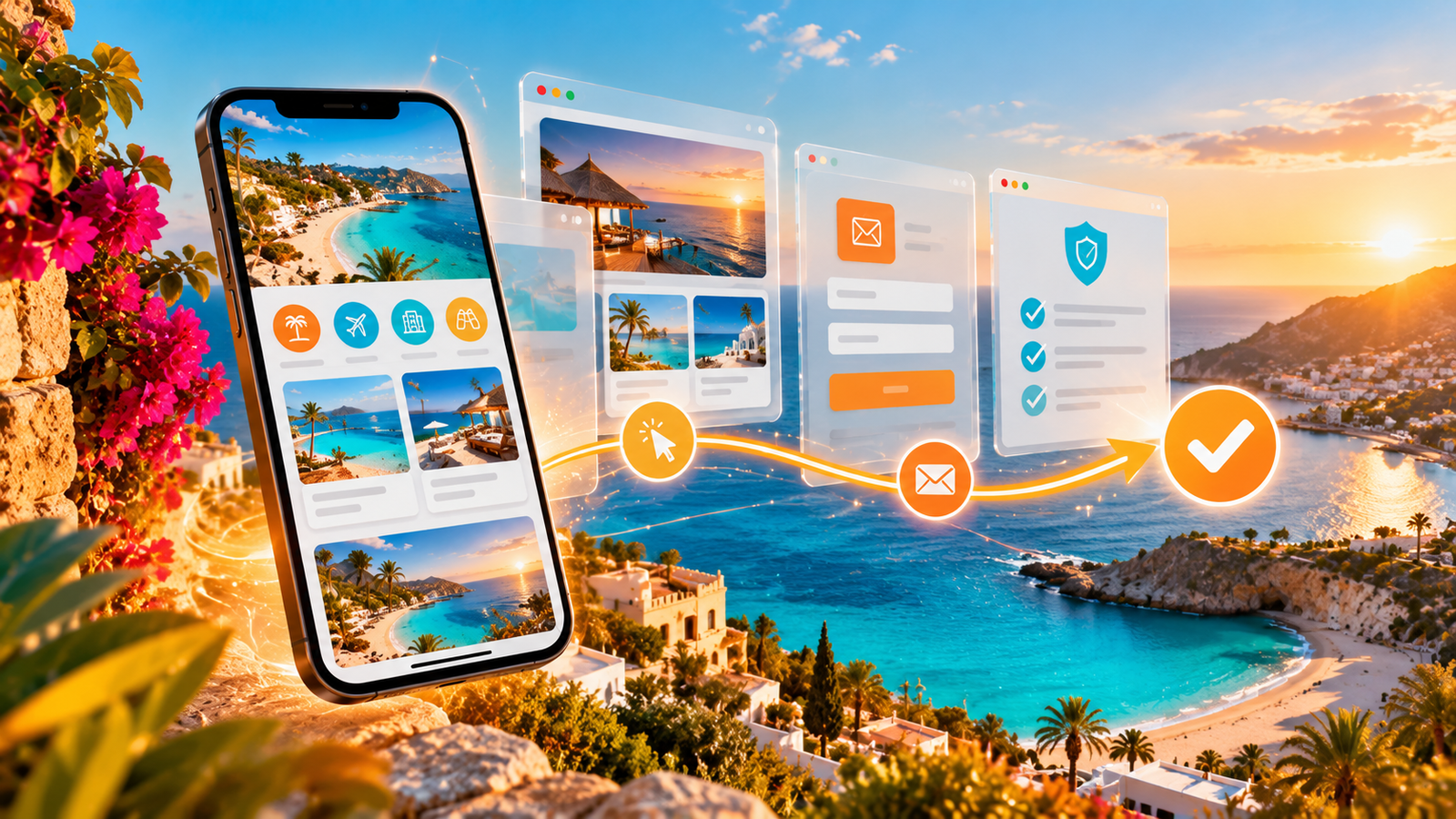
Think of the journey as a short sequence: arrival, relevance, reassurance, enquiry and response . The visitor needs to recognise that the page matches their interest, understand why your help is valuable, feel confident enough to share their requirements and receive confirmation that the enquiry reached somebody.
If your existing site needs a broader health check, our guide to auditing your travel website in autumn is a useful companion. The focus here is not fixing every design detail, but removing the specific obstacles between a visitor and an enquiry.
Tell visitors exactly who you help
A statement such as "We make holiday dreams come true" is friendly, but it does not help somebody decide whether you are the right person. A prospective customer wants to know what kinds of trips you arrange, what your expertise covers and whether you understand their particular needs.
A travel consultant who works frequently with families might explain that they help parents compare suitable room arrangements, child-friendly facilities and flight times. Somebody specialising in cruises could mention itineraries, cabin choices and the different experience offered by individual cruise lines. The wording should reflect genuine experience and approved products, not a specialism invented because it sounds good for search engines.
Keep your introduction conversational. Visitors do not need to read your entire life story before contacting you, but a genuine photograph, a short explanation of how you work and a clear description of the service can make a small independent business feel more approachable.
If you are new to travel homeworking, you can begin developing your voice during training, but do not present yourself as authorised to sell products or accept bookings before the required training and permissions are in place.
Make the next step feel useful, not demanding
A button labelled "Contact Us" is better than nothing, but it may be too vague when the visitor has just finished reading an informative guide. The next step should relate to what they were considering.
Match the invitation to the page
After a winter-sun guide, an invitation such as "Tell me when you want to travel and the kind of sunshine you prefer" follows naturally. A cruise article could invite the reader to discuss their ideal itinerary and sailing dates. An article about starting a travel business should direct prospective consultants to accurate joining information and a discovery-call conversation, rather than to a customer holiday quotation form.
Do not put a sales invitation after every sentence. Give the reader useful content first, then include a clear, relevant next action at natural points, especially near the end of a page. Descriptive text links can work as well as buttons when the context is clear.
Offer a sensible alternative for people who are not ready
Some visitors want to compare ideas rather than ask for a quote today. They might appreciate a related article that answers their next question or a chance to return to your service page later. A family planning a 2028 celebration may not be ready to give exact dates, and a couple researching their first cruise may need time to decide which style of holiday appeals.
This is one reason a genuinely useful blog matters. Our guide to creating a travel blog that attracts the right clients explains how to develop articles that answer real questions instead of simply collecting search impressions.
Use reassurance where a visitor might hesitate
Booking travel can involve a substantial financial commitment. It is understandable that a first-time visitor may be cautious about using a consultant they have not met. Your website should explain who will help them, what will happen after they enquire and which business is responsible for the eventual booking.
For an independent travel consultant working through an established travel company, describe that relationship accurately. At The Independent Travel Consultants, consultants operate as self-employed travel professionals supported by Jamie Wake Travel's training, systems, approved supplier relationships and booking procedures. Client payments use the approved arrangements, including the PTS Trust Account where applicable. ATOL and other protections depend on the actual product and booking route, so the website must not imply that every travel service automatically has the same protection.
Genuine reviews can also reassure people, especially when they describe the consultant's communication, knowledge or care rather than merely saying that the destination was lovely. Always obtain appropriate permission for images and testimonials. Do not manufacture customer reviews, present supplier comments as personal client feedback or add regulatory logos you are not entitled to display.
For consultants who want to use video feedback appropriately, using video testimonials to build social proof explores a more personal approach to demonstrating the service behind the holiday.
Keep enquiry forms short enough to start a conversation
The form is where a visitor decides whether contacting you will be straightforward or hard work. Ask enough to establish a useful first conversation, but not everything you will eventually need to make a booking. Name, an appropriate contact method, a broad travel timeframe, party details and a short description of what they want may be enough to begin, depending on the service.
Do not require somebody to know their exact flight dates or hotel before asking for help choosing them. A family considering next August may only know the school-holiday window. A honeymoon couple might need ideas for destinations and have no preferred resort yet. A free-text box can be valuable because it gives the customer room to explain what matters to them.
Avoid requesting passport scans, sensitive medical details or payment card information in an ordinary public enquiry form. Only collect necessary data through appropriate approved systems at the relevant stage. Include a suitable privacy notice and keep optional marketing consent separate from submitting an enquiry.
When the form is submitted, the visitor should see a clear confirmation explaining what happens next. Check that the enquiry actually arrives in your approved CRM or inbox. A thank-you message is not proof that the notification has reached you. Our guide to making travel enquiry forms more effective covers the form itself in greater depth.
Do not overlook the small screen
Even a website that looks attractive on a laptop may become difficult to use on a phone. Buttons may sit too close together, a menu may cover the content, and a long form may be unpleasant to complete using a small keyboard. Test the actual journey on a mobile device rather than relying only on the website builder's preview.
Open a destination article, try the main links, find the enquiry option and complete a fictional test form. Check that headings remain readable, required fields are labelled, error messages explain what happened and the visitor does not lose the information they entered when correcting something.
Accessibility matters as well. Use meaningful link wording, readable colour contrast, keyboard-friendly controls, helpful image descriptions and captions or equivalent text for video information. Clear writing benefits everybody, including customers who use assistive technology or simply prefer not to watch a video.
The wider technical preparation work is covered in getting your travel website ready for the booking rush. You do not need to rebuild everything to make the enquiry journey noticeably clearer.
Make your content answer the question that brought someone there
Search traffic can be misleading when you only look at the total number of visits. A page explaining what a travel homeworker does may attract people considering the career, whereas an article about choosing a Maldives resort may attract holidaymakers. Those are both useful audiences for ITC, but they need different information and destinations within the website.
Review the articles that already attract relevant interest and look at where they send the reader next. A good page does not have to contain an exhaustive list of supplier products. It needs to answer the searcher's question properly, explain the important considerations and then offer an appropriate next step.
For example, a helpful guide to family holidays in Tenerife might explain how the south and north of the island differ, which resort environments suit different families and why hotel pool facilities matter in winter. It can then offer the reader a chance to discuss dates, children's ages and preferred facilities. That invitation is much more natural than a general booking banner attached to every paragraph.
If your audience is made up of aspiring travel homeworkers, be equally transparent. Explain that running a travel business from home means self-employment, training, client acquisition, booking administration and responsibility for compliance. Someone clicking through to recruitment information should not discover the actual costs or requirements only after applying.
An enquiry is only successful when someone receives it
One of the easiest mistakes to miss is a broken connection behind a perfectly good-looking website form. Submissions might be saved in one place while notifications go to an old email address, or a spam filter may hide the message. If you use an automated workflow, a change to an integration can stop the information reaching the intended consultant.
Run a test from a clearly fictional customer identity. Confirm that the website acknowledges the enquiry, that the approved system records it, and that the right person is alerted. If there is more than one contact route, test each route separately, including mobile links and consultant profiles where applicable.
Once a genuine enquiry arrives, respond according to the customer's needs and the service level you can actually provide. Record preferences, answer outstanding questions and agree a useful next action. Do not send somebody into repeated marketing sequences simply because they submitted a holiday request. Our guide to following up travel enquiries without pressure explores what happens after that first contact.
Measure improvements without chasing vanity numbers
Start with a small number of meaningful measures: relevant page visits, successful enquiry submissions, genuinely qualified enquiries, form errors and the time it takes for an enquiry to receive a useful response. Where your analytics setup and consent arrangements allow it, track which content and channels introduce those conversations.
Keep definitions consistent. If you count sessions one month and individual users the next, your calculated conversion rate will not be comparable. Exclude your own test enquiries and obvious spam from the meaningful-enquiry total. A 5% conversion rate is not automatically better than 2% if most submissions are unsuitable or never become genuine conversations.
Be careful with visitor tracking and consent. UK privacy and electronic communications rules apply to non-essential cookies and similar tracking technologies. Do not add invasive analytics simply because a marketing guide recommends a dashboard. Use approved tools, obtain consent where required and focus on the information that genuinely helps you improve the service.
If you have only a modest number of visitors, large A/B testing experiments may not give you reliable conclusions. A simple before-and-after review, supported by a real usability test and notes about customer enquiries, can be a more proportionate starting point. Avoid claiming that one changed button has caused every subsequent booking.
Five improvements to make before spending more on traffic
You can begin with a short, manageable review of the pages that matter most rather than ordering a major redesign.
- Visit your most relevant page from a searcher's point of view. Check that the opening explains whom you help, what you offer and why the information is useful.
- Make the next step visible. Add a clear invitation that matches the subject of the page, such as discussing a destination or requesting personal holiday advice.
- Remove avoidable hesitation. Explain who will answer the enquiry, how the business works and what response the visitor can expect without inventing guarantees.
- Test the form and delivery. Complete the process on mobile, check its confirmation and verify that the enquiry reaches the approved system.
- Review the result. Note any errors, unclear questions or incomplete submissions. Fix the biggest practical problem first and then look again at enquiry quality.
These steps are deliberately achievable for a travel homeworker who may be balancing the business with employment or family commitments. They are not a promise of instant sales. They are a way to make sure the interest your content already creates has a better chance of turning into a professional conversation.
Jamie Says:
"There is no point spending hours writing content and attracting visitors if, when someone wants to talk to you, the next step is confusing or their enquiry disappears into the wrong inbox. I would rather have a smaller number of people contact a consultant knowing exactly what help they are asking for than hundreds of visits that lead nowhere. A good website should open a conversation, not make the customer work to find one."
Do you need your own website to become a travel homeworker?
Not necessarily. A website can be a valuable way to present your expertise and attract relevant enquiries, but it is not a substitute for learning how to run a travel business. Some consultants build a personal brand and website, while others develop relationships through recommendations, social media and approved public profiles.
The Independent Travel Consultants is the homeworking division of Jamie Wake Travel. Consultants are self-employed and build their own client base with online training, approved booking systems, supplier access and ongoing support. There is no joining fee, and the standard monthly service fee is £50. The standard consultant share starts at 80% of commission after applicable costs, not 80% of the customer's holiday price. Income is not guaranteed, and consultants must complete required training and follow approved booking procedures before accepting bookings.
Whether you have a personal website or not, the principle is the same: a customer should understand who you are, how to reach you and what happens next. If you are exploring this way of working, you can read more about joining The Independent Travel Consultants and developing your business before deciding whether a discovery call is right for you.
A note for members of the public
This guide is mainly written for people considering becoming travel homeworkers or improving their travel homeworking businesses. If you are here because you would like personal help planning a holiday, you are very welcome too. You can use our public directory to find an independent travel agent whose interests and experience suit the holiday you have in mind.
Frequently asked questions about travel website conversion
What does website conversion mean for an independent travel agent?
For an enquiry-led business, a useful website conversion is often a genuine customer enquiry rather than an immediate booking. The website should help a visitor understand the service and share enough about their trip for the consultant to start a worthwhile conversation.
What is a good website conversion rate for travel agents?
There is no universal percentage that applies to every travel consultancy. Results vary with traffic source, audience, page type, season and what counts as a conversion. Start by measuring your own genuine enquiries consistently and improving the experience instead of relying on an unexplained industry benchmark.
Should every travel article include an enquiry link?
Where it is helpful, yes, but the link should relate to the reader's purpose. A destination guide can invite holiday enquiries; a career article can direct people towards training and joining information. Avoid interrupting useful advice with constant sales prompts.
How many fields should a travel enquiry form contain?
Ask only what is needed to start the right conversation. Contact details, travel timing, party details and a short description are often enough. Exact requirements depend on the type of service, so test the form with real user needs in mind rather than forcing an arbitrary field count.
Can I improve enquiries without redesigning my whole website?
Yes. Clarifying the opening message, improving contextual links, fixing form errors and setting realistic response expectations can all be sensible early improvements. Test these basics before spending money on a major redesign or more advertising.
Can I use ITC's public directory instead of a personal website?
The public consultant directory can help customers find and contact an appropriate consultant. A personal site is not automatically essential to running a travel homeworking business. Whatever contact channels you use, keep information accurate and follow the approved procedures for enquiries and bookings.
Make it easy for the right client to begin a conversation
Turning visitors into enquiries is less about clever tricks and more about removing uncertainty. Tell people what you can help with, answer the questions that brought them to the page and offer a clear route to personal advice. Then make sure that every genuine enquiry actually reaches somebody who can respond.
If you are considering building a travel business from home and would like to understand the training, systems, responsibilities and support behind The Independent Travel Consultants, get in touch to arrange a friendly discovery call. We will explain how the model works and answer your questions so you can decide whether it suits what you want to build.
About Jamie Wake
Jamie Wake is the founder of The Independent Travel Consultants and Jamie Wake Travel, helping people build sustainable travel businesses with practical training, supportive systems and genuine guidance behind them.
Having built his own travel business following redundancy, Jamie understands the uncertainty, determination and learning involved in starting something new. He combines hands-on experience of running a UK travel company with knowledge of travel sales, customer service, marketing, supplier relationships, compliance and day-to-day business operations.
Through The Independent Travel Consultants, Jamie shares practical, honest guidance about becoming a travel homeworker, attracting and supporting customers and building a business that feels personal, professional and sustainable—not simply chasing bookings at any cost.